
We Are All Connected

connected

So much of our time we spend planning. But no amount of planning can prepare us for some things. This is certainly true for the loved ones of the Virginia TV reporter and camera man who were gunned down this week while doing a live interview. This latest tragedy reinforces how vulnerable we all are, and how our lives and the lives of our loved ones can be changed forever in a split second. It also reinforces how connected we are.

According to the reports, the man who killed these two innocent people had been an employee of the same TV station, and had lost his job a couple of years previously. His act of violence appeared to be aimed at the TV station, not the individuals; they just happened to be connected to the station. They lost their lives due to that connection.

It is too early to tell if there are people who knew the gunman who had any indication of his plan; we may never know that. It is not uncommon, however, for someone contemplating a horrific act to give some clues of those plans to others. It is also not uncommon for those people to fail to let the authorities know what they know. When this happens, a tragedy cannot be averted. Of course, when someone with knowledge of someone else’s horrible plans reports such, that is no guarantee that the tragedy will be averted, but the individual has done all they could be expected to do.

What sense are we to make of this recent tragedy? Some will point to mental health issues, and the need to provide more and better mental health treatment. There is the need for that, regardless of any relationship to such in this situation. People who are mentally healthy do not kill others, nor do they make threats of such. Family members who are aware that a family member, friend, or even an acquaintance has mental health issues that could result in danger to others has a moral obligation to let someone know of such, or to intervene in some manner.  We are all too connected not to.

Some will point to the need for better gun control. Yes, we do need better gun control; most of us would agree with that, although there would be disagreement on the specific solutions. And as much I agree that “guns don’t kill people; people with guns kill people,” many will agree that there are too many people with guns who should not be able to get guns legally.

I am in no way implying that any of this was involved in the murder of the TV reporter and camera man. I have no knowledge of anything related to such. I am only mentioning these as variables that can be involved.

So, what is the point of this post? One point is my need to write about that which affects me, and this recent senseless killing affects me. Being a mother and a grandmother, I cannot imagine the grief of the loved ones of these two TV station staff who went to work on a day like any other, and were gunned down, never to see their loved ones again. I want all reading this to say a prayer for the families of these two innocent people. And I want us all to say a prayer of gratitude that we can hold our loved ones close, and never ever take that for granted. Our lives can change in a split second, and we could find our loved ones gone forever.

There is one more thing I want us to do. Look around, see who is hurting, and connect with them. It may be a teenager who struggles with feelings of inadequacy, and needs us to show we care. It may be an elderly loved one who lives alone, and sorely needs someone to just spend some time with them, just sitting with them. It may be a co worker who is negative, who it is easy to ignore, who needs to know that someone sees them as worthy enough to ask them to go to lunch. It may even be a child of yours who just needs you to put your phone or tablet down long enough to look them in the eye and give them your attention.

For we are all connected, and the connection should be positive.

It is now time for me to put this computer away, and spend time with my loved ones.

Patti signature

Posted in Relationships | Tagged , , , , | Leave a comment

Reality and Renewal

au

Last week I had the privilege of facilitating a strategic planning advance (my word for retreat!) at Auburn University.   Some of my research for that and the insights provided has me still pondering.  The Department head wanted some of the discussion to include resilience and renewal, since the faculty had just finished a very busy year, leaving some with feelings of overwork and needing to renew their spirit.  (I certainly appreciate the Department Head recognizing the need for this, and making it a part of the session.)  I could identify, not as much from a personal experience in my own work, but from many discussions with clients in the past few months. As I did my mental work for the session as well as research, I found some of the reasons for people feeling overworked and overwhelmed, and some solutions.  My research included some information from my notes of a session I attended almost a year ago at a leadership session of the Outdoor Industry. The term VUCA was mentioned as the new normal.  VUCA is an acronym for-Volatility, Uncertainty, Complexity, and Ambiguity.  Just think about that.  It rings true to others when I say it, and probably to you as well.  And at the same time that there is ever increasing complexity, there is an aversion to complexity, with many feeling the need to simplify.  That is probably the reason for the major success of the book, The Japanese art of Tidying Up. We are living in a global world, with an increase in global consciousness, and can no longer escape the political and economic unrest that is present on many levels worldwide.

In the US, confidence in public institutions including schools, churches and banks is at an all time low.  As a result of all of the VUCA, there is an epidemic of fatigue. People are looking for solutions in many places.  Many people are on a spiritual quest, for when the system doesn’t work, people look for higher authority.

Whereas spirituality is one way that some people manage VUCA, how people cope in general during times like this varies.   Some people cope with significant stress with external means such as alcohol and medications (prescription or otherwise.) If one is clinically depressed or has other mental health conditions, medication is often needed and should be used.  In the event of a major loss or other life changing event, such as the death of a loved one, medication (and hopefully talk therapy) may be needed for a period of time.  For the rest of us dealing with daily challenges, the following are better ways to manage those.

 13 Ways to Build Resilience 

  1. Have good, supportive relationships
  2. Reframe – see problems as surmountable
  3. Accept that change is a part of living
  4. Have goals and move toward them
  5. Take decisive action
  6. Have self awareness, self regulation, and self efficacy
  7. Be confident
  8. Develop perspective
  9. Be optimistic
  10. Practice self care-good nutrition, enough quality sleep, exercise, etc.
  11. Accept that failure and loss are a part of life
  12. Do not look for your self worth in your job
  13. Have a sense of purpose

Many people today are focusing on happiness, and finding that happiness does not come from external things.  It never has.  Current happiness research is even more telling about this.  *Happiness facts: 40% of our happiness comes from our daily life and the choices we make.  Our actions make a difference.  Only about 10% of our happiness comes from our circumstances (income, environment, etc.)  50% of the variation in our personal happiness comes from our genes.”

To manage VUCA effectively and all of its consequences remember the wise words of Dr. Seuss:

“Be who you are and say what you feel, because those who mind don’t matter, and those who matter don’t mind.”
-Dr. Seuss

 Patti signature


Posted in Leadership, Relationships | Tagged , , , | Leave a comment

The “How” to Create the Best Culture for Your Business

PicMonkey Collage

There is no magic to creating the right culture; it is simple, but not easy.  Think of different businesses that are known by the masses.  Apple, Starbucks and Chick fil a come to mind.  All of these are successful, and all are different.  Or, are they that different?  Perhaps it is appropriate to first look at their similarities and see if we can discern some of the secrets of their success, and then consider their differences.

Apple, Starbucks and Chick fil a all have similar products to other businesses, but their products are usually pricier.  People are willing to pay a premium for their computers at Apple, their coffee at Starbucks, and their chicken at Chick fil a.  None of these businesses are really competing on price; the budget focused customer is not their target market.

All three of these companies have a certain vibe in their stores, and it is an energetic and youthful vibe, regardless of the ages of the staff.  Another similarity is competent and helpful staff.  They exude a certain confidence, confidence in their product and confidence in themselves.

All three businesses are very successful, and that is not by accident, but by design.   From their Mission, Vision and Values statements (and you can be sure, they have those) to the daily decisions that are made, their strategy is clear.  They hire, train, and promote people who can succeed in their particular environment.  They also fire those who can’t or don‘t.  There is also a level of consistency found in these businesses that is too often lacking in other businesses with same or similar products.  For example, when traveling by car I usually choose to stop for lunch at a Chick fil a, and have not been disappointed.  The food quality is consistent across state lines, and the staff is clean and friendly.   I can also expect long lines in the drive through, regardless of the time of day, and I (even being impatient,) am willing to wait, for I know the lines move quickly.  I also know that I will not find a Chick fil a open on Sunday anywhere, for the corporate Values preclude that.

Perhaps even more than Starbucks or Chick fil a, Apple is heralded as an example of greatness.  People stand in lines for hours and even days waiting on new releases.  Apple’s strategy of continual innovation (or planned obsolescence!) is well known.   Although the cost of the computers can be more than 2x the cost of others, many people are willing to pay the difference.  While for many years Apple computers were more attractive to creative types and the PC to business people, that is no longer the case.  Apple has become more successful lately at widening its net and attracting die hard PC users.  The security of Apple computers is well documented, and service problems are reported to occur much less often with Apple products than with PCs.  And when service problems do occur, one can expect to talk with an understandable and respectful English speaking person.

So, how are these cultures created?  First of all, by design.  There is a clear strategy, and it does not include, “be all things to all people.” For the Apple, Chick fil a, and Starbucks customer must be willing to pay a premium for their products, and everyone is not willing (and it should be noted, some are not able) to do that.   (But as for not being “able” to pay the premium price, one only has to see the guests at Disney who do not appear to be able to afford those prices to know that if the experience is valued, customers find a way to pay.)

These successful businesses hire the right kind of people, the kind of people who will represent their corporate Values to their customers.  As an example, while extreme tattoos are common and visible on Apple and Starbucks staff, they aren’t on Chick fil a staff.

Then there is the issue of good Systems.  There are many types of systems in companies, some technological, such as computer systems, and others systems, such as management systems and systems of communication.  These systems in successful companies work both for the staff and the paying customer, which result in efficiencies, productivity and profit.  The amount of money many companies waste due to turnover of staff and the exorbitant cost of advertising, hiring, and training, is nothing short of amazing.

The “How” of creating the right culture, the culture that will result in success for individual companies is simple: Strategy, People and Systems.  Any weakness in any of these three areas will eventually result in failure for a company.

While this is simple, it isn’t easy.  But true success is never easy.

Patti signature

Posted in Leadership | Tagged , , , , , | 1 Comment

Culture Drives Behavior

1392512798_french-fries

I fear it is getting worse.  While that thought can apply to more than one thing, you might wonder what “it” is in this article.  While I could label what I’m referring to as “customer service,” and say that customer service is getting worse, and it is, that is not the “it” is to which I am referring.  For “customer service,” or “customer disservice,” as I called it in last week’s blog post, is too general of a term for this subject.  The “It” I am referencing in this post that is getting worse is attention to detail.  I see it everywhere, I believe I know at least some of the reasons for the problem, and I recommend some solutions.

Examples include people implying they hear your instructions clearly, act like they will meet your request, then do not.  Last night at dinner it happened again.  Several of us were out for dinner at our neighborhood “Cheers.”  Since too many times the fries are delivered cold, we told the server to please make sure the fries arrived hot, or we would send them back.  We were not trying to be difficult; quite the contrary.  In addition to wanting quality food, we were trying to save the restaurant time and money.  All to not avail, for the fries were delivered lukewarm.  True to our word, we sent them back, and were fairly quickly served delicious hot fries.  I don’t think this problem would have occurred at Chick Fil A.  Not that a problem with food quality never occurs at Chick Fil A, for no one and no establishment are totally error free, but it is rare at Chick Fil A for the food to be less than expected on any level.  And that is not just an opinion of mine; many people use Chick Fil A as the best example of many good things.

What creates the difference between our neighborhood “Cheers” and Chick Fil A?  Culture.  While our neighborhood place does many things right and we support them a lot with our presence and money, they make too many mistakes like the one mentioned.  And while those mistakes cause us momentary delays and frustration, what it costs the restaurant in wasted food and staff time is significant.

My friend Pam just returned from an upscale cruise, and was giving examples of that culture.   Politeness, attention to detail, all requests met promptly and at a high level of quality, etc.  Culture stuff.  I could not help but compare that to a  cruise I took some years ago, and my cruise experience came up short.  The difference isn’t just cost; that is too simplistic an answer.  The difference is culture.  The upscale cruise has a clientele that expects a high level of quality, and the cruise line culture delivers that, while my cruise experience was on a cruise line that appeals to a clientele more interested in best price than exceptional experience. (I have not, nor will I travel on the cruise line I experienced again.  I have taken several other cruises since then, all different, but all acceptable.)  Culture drives behavior.

Other than the obvious, hire the right kind of people and train them well, how does a business create the right culture for their customers?  And what are the challenges in doing so?

The answer lies with leadership, for the leaders of an organization are the ones who establish the culture, by design, either intentionally or unintentionally.  And the culture stuff starts with Values.  And not Values printed on the wall, but the “walk the talk” values.  If teamwork is listed as a value and people work in silos, teamwork isn’t a value at all.  If empowerment is listed as a value and management controls all of the decisions, empowerment isn’t a value at all.

What are the challenges in creating a culture in which attention to detail, the detail most important to each organization’s customers, is a value?  One significant challenge is that younger people (and many service workers are younger) do not have a focus for the attention to detail needed. Think about it.  The technology driven world in which younger people live values speed more than focus, with the average attention span of Gen Zs (those born since 1995) being 8 seconds!  (Credit to Demand Worldwide for this fact.) They consider texting is conversation, and it is, but not face-to-face in which the nonverbal helps deliver the right message.

Back to my restaurant experience last night.  The server was pleasant and attentive.  She gave the impression that she cared.  I think she listened and heard our request for hot fries.  I don’t think she delivered the message to the kitchen, nor even noticed that the fries weren’t hot before she delivered them to us.  She probably assumed that of course the fries would leave the kitchen hot, and failed to notice that they weren’t. I consider this an example of lack of attention to detail and lack of focus.  It is also possible that she listened but did not hear, or that she heard, and failed to take initiative, accept responsibility and/or follow through.  Regardless of the reason (s,) money and staff time were wasted.

Culture drives behavior.  In this post the focus is on the “What” and “Why.” And this is certainly not an all inclusive analysis of either. Next week’s post will be on the “How,” how to create the right culture.

As always, I invite and welcome your thoughts. And thank you for honoring me by reading my thoughts.

Patti signature


Posted in Relationships | Leave a comment

Customer Disservice

Dissatisfied-Customer-185x185

There have been many examples of lack of service that I have experienced lately, and likely, you as well. It makes me wonder how businesses expect to stay in business! Is the customer no longer important at all? Do companies not realize they could lose their most valuable asset, the paying customer? Do companies not know that it is the customer who puts food on their table? When are we going to say, “Enough!” and just take our business elsewhere? Unfortunately, it isn’t that simple.

First of all, some companies that we do business with do not have much if any competition, and in those cases, we are stuck trying to make our relationship with them work. There may be businesses with comparable products or services, but not the same, and we are not satisfied with “comparable,” we want the same. So we keep on trying to be satisfied, and often aren’t.

Then, sometimes it takes too much time to find another company that is any better than the one with which we are dissatisfied, so we keep putting up and putting up with lousy service. Sometimes we just don’t have the time or don’t take the time to take our business elsewhere. In customer service circles it has long been known that it is easier to keep a customer, even when the customer is unhappy, than it is to get new customers. The sheer time and effort it takes to move our business elsewhere is often more than we think we have to spend on that process. So the cycle of customer disservice goes on.

Lately I have noticed that many companies are doing what can be called, “smiles training.” “Smiles training” includes responses to a customer’s concerns that are obviously out of a cookbook of customer service training. Phrases mentioned such as, “I hear that you are frustrated, and I apologize for that” almost send me up the wall! I sometimes reply, “I appreciate the apology, but what I really need is a solution to this problem.” Actually, that isn’t totally honest. What I have actually said is, “I don’t want your apology; I want a solution to this problem!” Now, those responses of mine are very different, aren’t they? And while I know that the gentler approach is friendlier on my part, I honestly have not usually found that a solution is any more forthcoming with the nicer approach. But it is still the right approach. I should be nice, and often I am. After all, the person on the other end of the line is only doing what she/he has been told to do. The accountability for this is with the management of the company, not the employee. You know “smiles training” when you hear it. It includes the person giving you your burger at 8pm who doesn’t even make eye contact and yet says, “Have a nice day.” I want to reply, “The day is over, it is the evening!” This problem is so commonplace that I recommend in my customer service training that “have a nice day” not even be said. Instead, say something like, “Thank you for coming in; we appreciate your business.” Now that connects directly with the customer. Who doesn’t want to feel appreciated for their business?

Then there is the customer disservice of many companies’ telephone system including voicemail. I called a business recently and the voicemail message was, “If your call isn’t returned in 48 hours, feel free to call back.” 48 hours! And if the customer doesn’t get a call back in 48 hours, the responsibility is put upon them to initiate another call! I ordered something on line from Amazon on Saturday and was told it would arrive on Tuesday. It arrived a day early, on Monday! Is it any wonder that many people choose to order items such as toilet paper, paper towels and other regular essentials on line, avoiding the customer disservice of local businesses? And when those local businesses go OUT of business because they failed to provide service, they will blame the big boxes!   It is so much easier to blame others for our failures than to change the things we need to change.

This issue of Customer Disservice is such an important topic that we will visit it again. We need to hold companies we do business with accountable for putting food on their tables.Patti signature


Posted in Relationships | Tagged , , , , | Leave a comment

Changing What Isn’t Working

download

I speak, consult and write on Change, and I feel like an imposter today.  I am dealing with a change that is immobilizing me.  I made the leap today and bought a MAC, and I fear that I will not be able to make the transition from a PC to the MAC.  So many people have told me that I will love the MAC, once I get used to it, and to allow a 30 day “getting used to it” timeframe.  I spent several hours today at the Apple store with staff younger than my children trying to teach me what I need to know to get me out of the store as quickly as possible!   Then I spent about the same time with my tech guy trying to continue the learning, mostly to no avail.  So here I am, trying to figure out how to write this Blog Post on my new MAC.  I gave up, and am writing on my old Dell computer!  I found the Word icon on the MAC, but when I opened that, I could not figure out how to type in it.  I am sure that there is an easy solution to this, but I can’t find it, and I do not have the patience to try to figure it out.   So, while the MAC is pretty and new and may do more than my old Dell computer, it isn’t working for me (yet,) so I go back to the familiar!  This reminds me of other changes that I have made, and how easy it is to revert back to the familiar, and what can keep me focused on the new and different until IT becomes familiar.

Some say it takes 30 days to make or break a habit.  I disagree.  My experience is that it takes at least 90 days, and even more.  The pull of the familiar is so strong that for a new habit to take hold requires the desire of the new to be so much stronger to overcome the resistance to change.  This is true even when what we have been doing isn’t working.  Back to my MAC and Dell computer example.  My Dell computer has been failing for at least a year.  The keys stick, resulting in the computer typing in different areas than I am typing, as well as emails sending before they are finished.  These problems have not been occasional ones, but constant aggravations.  Yes, I have had work done on the computer to try to fix the problems, but those attempts have not been successful.  Still, the learning curve required to make a change has held me captive to the familiar, even when I knew it wasn’t working.  This is so like other changes I have made, and continue to make.  So, what is required for change to take hold, and to maintain the change consistently?

I am reminded of the year that I decided to cure my spending habit, not purchasing anything for myself or our home for a year. (Other than “disposables,” such as makeup; those I could replace when I used up what I had, but could not buy anything new that I had not already been using.)  This year of no spending taught me some valuable lessons.  I recorded the journey, which will be a book published later this year.  Giving the change a year to take hold was what made it successful; 30 days or even 90 days would not have resulted in the change.

I do not plan for my transition to the MAC to take a year, but I believe it will take more than 30 days.  What will be required for the change to be successful?

First of all, this change requires a commitment to let go of the familiar.  Then, there must be a desire to learn how to become a successful MAC user.   Patience is required, which I lack.  Giving the change the appropriate amount of time will help me be successful.  Using the tools that are available, and learning from others are also ways in which I can make this change successful.  Other things are required as well, but I will hold those for another post.  The keys on this Dell PC are sticking so much that I am having to retype much of what I am writing.  Frustration has set in, so I will put this aside for the present.   I will go play with my new MAC.

Patti signature

Posted in Uncategorized | Leave a comment

Time Waits For No One

FullSizeRender

When I think of the fact that it is already the middle of July, I am amazed.  2015 is more than half over.  (No, I am NOT going to tell you how many days it is until Christmas!)  My focus is zeroing in on how the year is going.  For me, it is passing much too quickly, and I am not pleased with some of my lack of progress toward certain commitments I made to myself.  Some might call these goals, and that is ok, but I prefer the word “commitments.”   How about you?  Did you make some commitments to yourself at the beginning of the year?  Note that I did not refer to these as “New Year’s Resolutions,” and that is intentional.  Too often NYRs are only a game we play with ourselves, not really committed to the changes that would be required to keep them.  Well, regardless of progress made or not made to date this year, we can only go forward.  We have no opportunity to change anything that has passed.  So, instead of lamenting on what we have not done, let’s focus on the rest of the year, and recommit.  I developed a Three Part Process for Effectiveness that can be used as a model to assist us.

Part I is Plan.  Plan what you want, not what you don’t want.  Be positive in how it is stated, and use “I Will” language, being as specific as possible.  One of my plans (commitments to myself) for the remainder of the year is to begin to exercise again.  I have not exercised for 9 months due to Bursitis in my hips.  The Bursitis is still with me, and I do not know if it will ever be gone completely.  So, I have decided to get moving again anyway.  My plan for this is to Exercise at least three hours a week from July 15th to August 21st.  I do not plan to stop there, but to determine how the exercise is affecting the hips, and increase or decrease the amount of exercise as appropriate.  I have a couple of other commitments/goals/plans, but I will not list those.  You need to focus on yours, not mine!  I am sharing mine only as an example.

Part II is Purge.  Purge is eliminating whatever is in our way, blocking us from keeping our commitments.  In my case, I will Purge clutter in my office, home and car.  I know that when I have clutter around me, I am not productive or able to keep my commitments to myself.  It is hard for me to quantify this, although a reasonable expectation is that I will need to commit at least an hour a day to de- cluttering between now and whenever I conquer the clutter monster. So, that can be how I record this commitment; de-clutter for at least an hour a day five days a week in my office, home and car, as needed.

Part three is Perform.  Although Perform and Plan are similar, they are not the same.  Performing involves doing whatever is required for the plan to come to fruition.  Regarding my commitment to exercising, I will need to purchase new running shoes to be able to exercise, for the ones I have will make my Bursitis worse; they have needed to be replaced for months.  Perform can also include further specificity for the Plan.  An example of this is “Walk three mornings a week before nine am.”

The words, Plan, Purge and Perform are simple to remember, and can be a roadmap for making and keeping commitments to oneself.  Keep it simple and manageable.  You will note that my examples are personal, they do not include family.  It is fine if your written commitments include family, but I decided that mine for the remainder of the year do not need to.  I have spent considerable planned time with family this summer, and will spend more in these next few months without needing to make such a written commitment.  Making family a commitment is easy for me; making me a priority is not as easy.  And I am not getting any younger!  I need to focus on my personal health more than I often do.  It is quite possible that this Bursitis will improve with exercise, and that the exercise will result in the loss of the pounds I have gained as a result of not exercising.  One thing often leads to another, whether those things are healthy, or not.

This post isn’t really about a system or model for keeping commitments, although I have given an example of one.  It is about taking stock of where we are now, at this point in a year, and what we want to accomplish in the foreseeable future.  The reason for this is simple.  Time and life pass so quickly, whether or not we are paying attention.  My family (all 15+ of us) just returned from a week in Hilton Head.  We had a wonderful time together, and it was gone so quickly.  And such is life, not just vacations.  My soon to be 85 year old uncle was with us on this vacation, and as I said goodbye to him a few minutes ago, I cried.  He is going home three hours away to be mainly by himself.  Although he has friends around who watch out for him, it isn’t the same as being with family sharing memories.  Before he left he said, “I like being here where you wait on me; at home I have to do everything for myself.” At 84, he should have someone to wait on him, at least more regularly than our distance allows.

Time waits for no one.  Commit to yourself that the rest of 2015 will be what you plan for it to be, eliminating any barriers in your way, and performing at your best.

I wish you well on your journey.

Patti signature

Posted in Relationships | Leave a comment

When Freedom Rings

07.04.13news-flickr-american-flag

With the birth of our nation’s independence being celebrated this week, the subject of freedom comes to mind. Other things come to mind as well, some troubling. We are living in a very complex world, with many competing beliefs which may divide us.

One of the beliefs that can divide us is the recent concerns of evil and racism, with the murder of nine black people in Charleston. That horrific event has spawned the concerns about the confederate flag, and what that flag represents to people on both sides of the issue. I do not propose to know the right thing to do about the confederate flag as a country or even for the state of South Carolina. As a private citizen with no governmental accountability, I am not required to even debate the issue. But as one with a business committed to leadership, it is my responsibility to be thoughtful about these issues, and do all that I can to provide helpful information to others.   Is it helpful to have a symbol so divisive due to the very negative time in our nation’s history it represents to many people, waving above a governmental building in any state? I do understand the position of those who want to keep that flag waving because of its historical significance. Does the confederate flag’s historical significance warrant allowing that symbol to continue to polarize large groups of people? Is it possible that keeping that history alive contributes to keeping the hatred that such represents alive as well? Should we as a loving people choose to do anything that is a barrier to moving past that negative time in our history? Is it possible for us to have the freedom to choose to put that part of our history behind us in a tangible way by removing the confederate flag from all governmental buildings? And can we discuss this without attacking others with a different opinion?

The recent Supreme Court decision regarding marriage of same sex couples has created another area of polarized opinion. Much of this polarization is being played out on Facebook, and in a very mean spirited way. This is a very complex issue, with religious as well as legal beliefs involved. While we all should have the freedom to have our own opinion about this, too many people are attacking others for their beliefs. As a nation built on freedom, as individuals we do not lose our right to believe differently than others, even when laws change. As I think about this freedom I am reminded of something my daughter Tara said to me years ago. I was “ranting and raving” (as I still can do!) about something political, to which she replied, “Mom, don’t complain to me about it! If you want it changed, run for political office, and be a part of the legislative process that can make it happen!” She was wise beyond her years, for that is how many things change in our country, through the legislative process. Too many times all I do is complain about those things with which I disagree, and don’t take action in ways that I could to try to be a part of creating positive change. And the tag line of my business is “Inspiring Positive Change in Work, Life and Family! While I (and you) can do some things as private citizens, major social changes happen at some point through the legislative process.   Being a part of electing legislators who will work tirelessly to pass legislation to make changes consistent with what we believe is best for our country and its citizens is one action we can take as private citizens. And the fact that some have done so, and done so quite effectively, is one reason we are experiencing major social change. So, regardless of what we think about these changes, can we be civil to each other? Do we not value our freedom to have different beliefs and to work together peacefully? If not, is it too far out to imagine that even more evil can come our way? We have graphic examples, past and present, of the failure of some societies to respect the rights of others, failures that have resulted in terrible outcomes, so terrible that I can’t even write the words. I shudder to even think about the possibilities.

When freedom rings, there will be decisions with which we will agree, and those which we strongly oppose. I urge us all to represent our opinions with civility and respect. If not, do we really believe in freedom after all, or only those freedoms with which we agree?

May your July 4th holiday be safe, fun, and mindful.

Patti signature

Posted in Relationships | Leave a comment

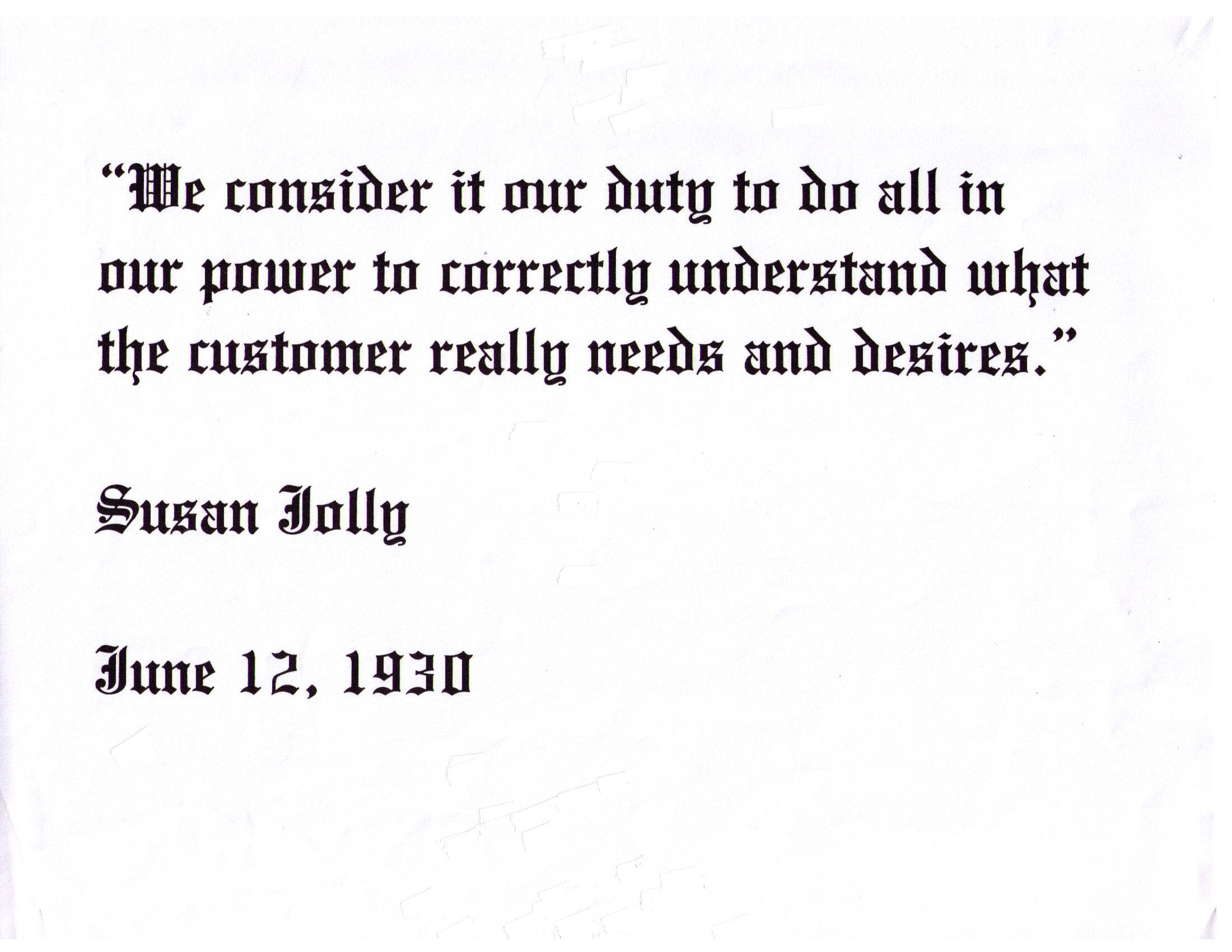
Don’t (Just) Do What You Are Told; Think for the Customer!

Susan Jolly Quote

My husband and I are in the process of renovating our beach condos.  We have two on the same landing; one we rent, and one we use for us personally, and also share with our family and friends.  These condos have undergone (required) extensive exterior renovation by the condominium association, and we just moved back into them at the end of May.  Mike and I decided that it was time to do some interior renovation, including bathrooms, floors, and kitchen cabinets and countertop in our personal condo.  We began this interior renovation hoping that we would be able to get the rental condo finished quickly, and made this known to all involved.  It was an aggressive time frame, but all involved knew that, and assumed that we could finish the work in the timeframe desirable.  As is often the case, things haven’t gone according to plan.  Some of this is unavoidable, and some is quite avoidable.  Sharing some lessons learned from this experience may help others experiencing similar events.  These lessons can help navigate what can be frustrating experience.

  1. Assume that you must be the expert, and serve as your own GC. This means that you need to know the questions that need to be answered.  In our case, this included knowing to mention that the repair line needed to be replaced, not just the toilet, cabinet and countertop.  Why would we replace everything else and not replace that piece that was rusted?  But the person who sold the bathroom fixtures to us as well as the plumbers who replaced the items never mentioned that pipe, nor asked us if we wanted that pipe replaced.  We only noticed it after the plumbers had finished the work and left.  When they returned to check a couple of toilets that weren’t working as expected, I asked about that pipe, and was told, “We weren’t told to replace it; we just do what we are told.”  This answer resulted in my customer service sermon on doing more than you are told, and thinking for the customer.  At least ask the questions.
  2. Expect problems, and allow time for those to be fixed. In our case that included tub fittings not being available for a more than 30 year old tub, a faucet being installed on a stainless sink that isn’t strong enough for it so it wobbles, and the living area of the rental condo being painted the wrong color.  The solution for the tub fitting was found, but it was chrome, and the rest of the fittings that were already installed are brushed nickel.  We chose to live with the difference instead of replacing the fixtures and having the subsequent cost of replacing the brushed nickel fittings with chrome.  The same was the decision for the painting that was wrong.  We are still dealing with the sink and new faucet that wobbles; we haven’t settled on the best solution for that yet.
  3. Be nice, in spite of it all, but stay firm in what is your responsibility, and what is the responsibility of others involved, such as the GC, the suppliers, and (in our case) the plumbers.  This isn’t always easy to figure out.  Who should be responsible for the costs and the delays in the case of the sink which won’t accommodate the new faucet which is so heavy that it wobbles?  Should the customer know that is a potential problem?  I don’t think so.  What about the supplier who sold the faucet to the customer?  Was there due diligence that wasn’t done?     And the plumber who installed the faucet and left it without mentioning the problem to the customer?  Not good customer service.  But what about the cost?  Any solution to the problem will cost more to correct the problem, and who should be responsible for that?  That isn’t an easy question to answer.  But it is a given that that this will be costly.
  4. Expect and be willing to accept less than perfection, or you will go crazy! Chrome may have to coexist with brushed nickel, and yes, it costs more for less than desirable, but so be it.  Stuff happens.
  5. It is true that things will take longer than expected and cost twice as much, so plan for that. I have already mentioned some examples of this. Also, in our case this means that our rental condo will not be available for rental as quickly as desirable and expected, and even when it is, it will not be finished to my satisfaction.  Costly unanticipated problems have occurred, and have resulted in a less than desirable final product.  But what we have is far better than what we had, and we should not forget that.

This renovation project is a lot like life, I think.

Patti signature

Posted in Relationships | Tagged , , , , , , | Leave a comment

A Friend’s Perspective on Beauty and Friendship

FullSizeRender (3)

I am most fortunate to belong to a group of women friends who have been in a Lunch Bunch together for more than ten years.  We take turns treating our group to lunch once a month. (Most of us are also in the same book club.) We range in age from early 40’s to mid 70’s.

While we choose wonderful restaurants for our lunches, we consider our time together and our discussions on a variety of topics even more fulfilling than the food.  Now, that is saying a lot, since we are also foodies!  At our most recent lunch gathering, we discussed aging, and asked each other’s opinions on several aging related challenges, such as loss of hair from eyebrows and eyelashes.  Yes, really!

When I received the following from one of our members, Jean, it touched me so profoundly that I asked her permission to share it on the blog.  She graciously agreed.  I give it to you as a gift given to our Lunch Bunch.  And if you don’t have a group of women friends who you share such times with, do go out and create one!

Subject: Re: Yesterday’s discussion

Dearest Youngsters,

I am thrilled to see you all so engaged in what the future will bring.  As a happily mature, physically active, strong, (I can bench press my weight; the fatter I get the stronger I become) and gratefully healthy woman who is eagerly hoping to reach 70 in a few months, please let me assure you that concerns about age are completely within your control. I have often been told that while you can’t stop the progress of time, you can control how you age because getting old is heart and mind over matter.

Even in my advanced years I remain unsure what it is people fear about getting older. Time has bestowed freedom that I never imagined.  And I still have a problem buying into any definition of beauty. Society and reality keep changing it.

Once I thought it was really fair skin and straight hair,  But folks with fair skin subjected themselves to tanning, risking cancer and struggled to keep straight hair curled.  A fellow cancer survivor who also lost her hair to chemo told me she prayed that it would not come back straight.

I just wanted mine to come back.  These days I am happy to have some and take much joy in the many textures it displays, as I am sure you all have noticed!

I am also counting on Jan to let me in on whatever that drug is that will grow my eyelashes and pray that I will remember to apply it. Loss of memory is a casualty of age. It is also a casualty of chemo. I chose which to blame depending on the situation. Freedom!

Once I thought beauty was youth but the fashion industry got in trouble exploiting teens and preteens.  They needed the young ones because 18 year olds were already too old. Dying young is the answer?  No way.

Then I thought beauty was a tall, lean body but  I’m barely five feet and really like to and eat. Can’t buy into that definition either.

Yesterday I watched all who shared the table and saw that beauty is your elegant and captivating maturity, essentially the evolution of youth. Dominant traits on display were confidence, security, intellect, generosity, honesty, integrity, joy, flexibility, humor, loyalty, introspection, and hope for the future; so many traits that make you the special group of women Jan so astutely recognized.

Beauty was in abundance but it had nothing to do with physical appearance. It is the joyful way you love.

That, ladies, resides in your heart and mind, beautiful through the ages. Hang on to what you have because you are all grand and glorious.

Much love,

Jean

Patti signature

Posted in Relationships | Tagged , | Leave a comment